
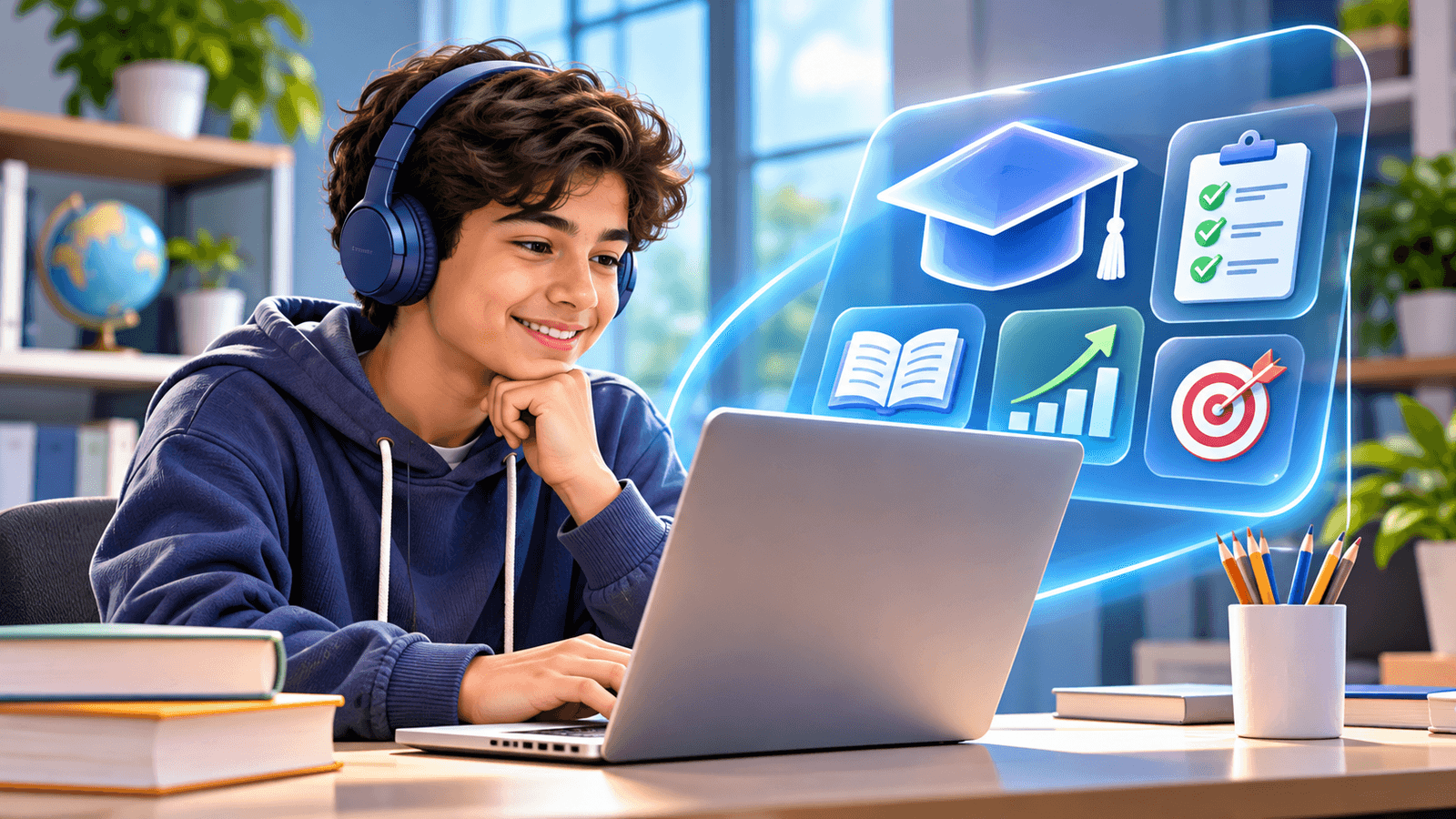
Discover how a personalised AI tutor could transform education through adaptive learning while preserving the essential human touch of teachers.
Every teacher knows the moment: one student has understood the explanation, another is almost there, and a third is still unsure where to begin. All three are looking at the same board. The challenge is not a lack of effort from teachers. It is that a classroom cannot always move at the exact pace of every learner. AI tutoring offers a possible way to close some of that gap. Instead of delivering the same lesson over and over, a well-designed AI tutor can ask a student what they know, work through an example and adapt the next question to the answer. This is an opportunity, not a guarantee: the quality of the teaching design matters more than the sophistication of the chatbot.
From giving answers to teaching understanding
Consider a student who types, “I do not understand simultaneous equations.” A weak AI tool simply supplies a solved equation. A better tutor asks which step is confusing, writes out a small example, invites the student to attempt the next step and checks the reasoning. If the learner makes the same mistake again, the tutor changes approach rather than repeating the same wording. Interactive whiteboards make this especially promising for mathematics, science and other visual subjects. An equation can be built line by line. A diagram can be labelled as the discussion develops. The student can interrupt, ask a question and attempt a similar problem. The goal is active learning, not a convincing performance of teaching.
Understanding a student over time
One of the most useful possibilities is continuity. Imagine a tutor noticing that a student repeatedly confuses percentages with percentage points, even across different lessons. Rather than starting from zero each session, a responsible system can use a limited, secure learning history to suggest review questions and track whether the misunderstanding has been corrected. This kind of progress profile should focus on learning needs: topics covered, mistakes, confidence and next steps. It should not become a permanent label that tells a child they are “bad at maths.” Students and families deserve understandable privacy controls, proportionate retention and clear options to review and delete saved information.
What the Quiz Portal AI Tutor project is designed to do
Quiz Portal, already offers free exam practice. Its accompanying AI Tutor project goes a step further in design: a subject-based classroom experience with a live whiteboard, voice interaction, student questions, course-specific learning paths and progress history. The project documentation also describes a limited introductory trial, scheduled class allowances and a course catalogue spanning Cambridge subjects and SAT preparation. It is important to distinguish the plan from the live experience. The supplied November 2026 project package identifies the AI Tutor student interface as a prototype whose teaching replies are simulated until its server integration is deployed. Families should therefore check the current website for availability live features and pricing before assuming those capabilities can already be purchased or used.
What about handwritten homework and photographs?
Image-based study help could make tutoring much more practical. A student might photograph a handwritten working, a graph or a paragraph and ask where their reasoning went off track. But accurate image reading is not the same as accurate teaching. OCR can misread a minus sign, a subscript or a diagram label; an AI tutor must confirm uncertain details rather than build a confident explanation on a bad transcription. The best workflow is to show the detected question to the student, ask them to verify it, work through the reasoning and encourage comparison with classroom notes or an authoritative syllabus. It should be easy to say, “That is not what I wrote.”
The teacher remains essential
An AI tutor may help a student practise at 9 p.m. or revisit an awkward topic without embarrassment. It cannot fully replace the insight of a teacher who knows the classroom, notices a child’s mood or judges when a different kind of support is needed. Teachers remain responsible for curriculum decisions, assessment and pastoral care. UNESCO’s guidance on generative AI in education emphasises human-centred use, age-appropriate safeguards and data protection. Those principles should shape product design from the beginning. Schools should also check AI output for errors, avoid uncritical automation of grading and make clear when a student is interacting with a machine.
A practical way to introduce AI tutoring
Start small. Choose one difficult topic, use the AI tutor for a short guided session, then complete an independent question without assistance. The next day, ask the learner to explain the solution aloud or on paper. If understanding transfers beyond the chat, the session was useful. If the student can only reproduce what the tutor showed, more teaching is needed. The future of education should not be a choice between AI and teachers. It should be a better division of work: teachers build relationships and judgement; quality learning tools provide extra explanations, practice and timely feedback. For students who want to strengthen foundational knowledge today, the free practice resources are a practical place to begin.
Editorial references
Frequently asked questions
No. AI can supplement practice and explanations, but teachers provide curricular judgement, care, context and accountability that an automated system cannot fully provide.
A carefully designed tutor can break down topics, ask diagnostic questions and revisit recurring mistakes. Its explanations still need quality checks and human oversight.
Suitability depends on age, design, supervision, privacy measures and the task. Parents and schools should review the provider’s safeguards before use.