
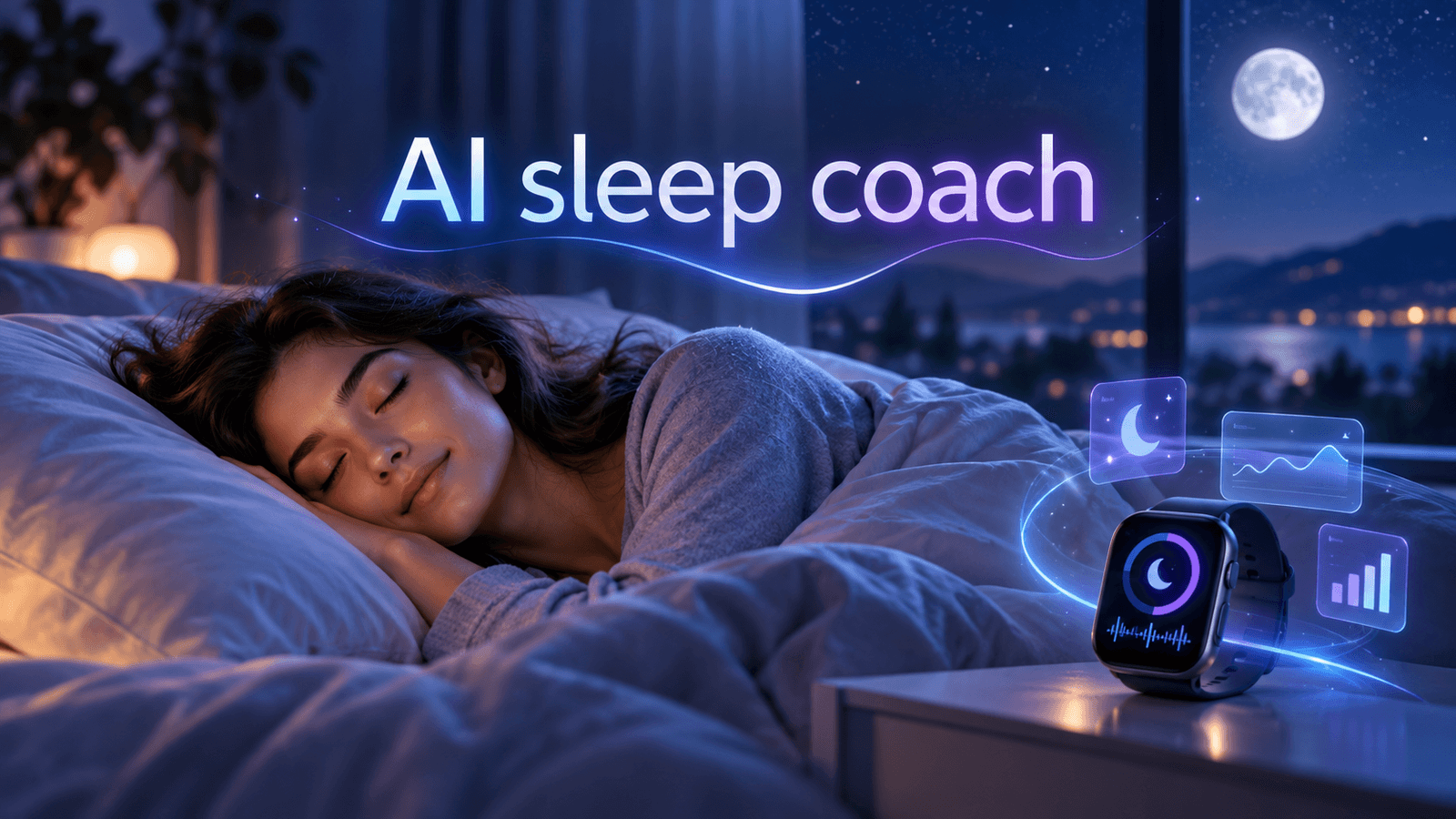
Build an AI sleep coach that turns wearable sleep data into personalized daily plans, smarter habits, recovery guidance, and recurring subscription value.
An AI sleep coach could turn raw wearable data—sleep duration, consistency, interruptions, recovery signals, activity and user habits into a simple daily action plan. Instead of showing another dashboard full of scores the app would explain what changed, what may have influenced sleep, and what the user can realistically adjust tonight. The strongest product opportunity is therefore interpretation and habit coaching, not simply sleep measurement.
An AI sleep coach could turn raw wearable data—sleep duration, consistency, interruptions, recovery signals, activity and user habits into a simple daily action plan. Instead of showing another dashboard full of scores the app would explain what changed, what may have influenced sleep, and what the user can realistically adjust tonight. The strongest product opportunity is therefore interpretation and habit coaching, not simply sleep measurement.
Why an AI Sleep Coach Is an Interesting App Opportunity
Wearables already collect increasingly detailed sleep information. Apple Watch, for example, estimates REM, Core and Deep sleep and provides sleep trends while newer Apple health features connect sleep and other physiological signals with daily readiness guidance. WHOOP similarly combines sleep, recovery, strain and lifestyle context to provide personalized guidance, while Oura Advisor uses health sensing algorithms and an LLM to answer questions using a member's biometric data. The opportunity is the gap between collecting data and knowing what to do with it.
What the App Could Actually Do
A focused AI sleep app could connect with supported health and wearable platforms, identify patterns and create a short morning briefing:
- What changed in last night's sleep
- Which recent habits correlate with better or worse nights
- A suggested bedtime or wind-down target
- Recovery-aware exercise and activity suggestions
- Small experiments users can test for several nights
For example, instead of displaying “Sleep Score: 68,” the coach might explain that bedtime inconsistency increased during the week and suggest maintaining a narrower bedtime window for the next three nights.
AI Sleep Coach Business Model and Path to $10K/Month
A practical MVP could use freemium pricing:
Free: basic sleep summaries and limited insights Plus: $9.99/month for personalized plans and historical analysis Pro: $19.99/month for advanced wearable insights, AI conversations and deeper habit correlations
An illustrative route to roughly $10,000 MRR could be 800 Plus subscribers × $9.99 plus 100 Pro subscribers × $19.99 = about $9,991/month. This is a business target, not a revenue guarantee. Subscription retention would depend on delivering useful insights repeatedly rather than generic wellness advice.
Privacy Could Become a Product Advantage
Sleep history and health signals are sensitive personal data. A credible product should minimize unnecessary collection, clearly explain AI processing and provide granular controls over connected information.
Entrepreneurs researching privacy-focused AI architecture can also explore this private AI for small business guide when considering how sensitive AI workflows should be designed.
A Related Health-App Model: Personalized Tracking
AI-assisted personalization is already appearing across other health categories. The Lunear Period & Cycle Tracker combines personal tracking, pattern insights and an AI assistant, illustrating how a focused health app can turn repeated user data into more contextual guidance rather than isolated records.
Keep the MVP Narrow
The first release does not need medical diagnosis, complex clinical features or custom hardware. It could start with wearable imports, a sleep diary, AI-generated explanations, habit tracking and weekly pattern reports. Recent research also suggests wearable digital interventions can improve some sleep outcomes, although results vary and consumer apps should not present themselves as replacements for professional assessment or treatment.
A simple utility can also demonstrate the value of solving one problem clearly. Developers studying focused mobile-product design can review this Unit Converter App on the App Store as an example of a narrowly defined utility experience.
Want an AI Sleep Coach Built for Your Business?
If you want to explore an AI sleep coach, wearable-data platform or personalized wellness app, APPS-hunt.com can help turn the concept into an MVP designed around automation, recurring engagement and subscription revenue. Complete our short inquiry form to discuss your product idea.
Final Takeaway
The defensible opportunity is not another app that tells users how many hours they slept. Build an AI sleep coach that transforms existing wearable data into understandable explanations, small daily actions and measurable habit experiments. Validate willingness to pay before developing deeper integrations or health-related features.
Follow Apps Hunt for More App Opportunities
Follow Apps Hunt on Pintrest, Instagram and Youtube for more AI app opportunities, automation concepts, SaaS ideas and practical digital-business strategies.
Final Takeaway
The defensible opportunity is not another app that tells users how many hours they slept. Build an AI sleep coach that transforms existing wearable data into understandable explanations small daily actions and measurable habit experiments. Validate willingness to pay before developing deeper integrations or health-related features.
Frequently asked questions
An AI sleep coach is an app or digital feature that analyzes sleep and related lifestyle data to provide personalized explanations, recommendations and habit guidance.
It can combine wearable sleep data, user-entered habits and historical patterns, then use algorithms or AI models to summarize trends and suggest practical daily actions.
It may help users understand patterns and establish healthier habits, but results vary. It should not replace professional medical evaluation when someone has persistent or serious sleep problems.
Depending on available integrations, the app could use sleep duration, bedtime consistency, awakenings, activity, recovery signals and voluntarily entered lifestyle information.
Yes. A product could potentially integrate with supported health platforms and wearable ecosystems where their APIs and permissions allow access to relevant data.
Not automatically. A wellness app that provides general habit guidance differs from software making medical diagnoses or treatment claims. Developers should carefully evaluate applicable regulations before adding clinical functions.
A possible model could include a free tier and paid subscriptions around $9.99–$19.99 per month. These prices are illustrative and should be tested with actual target customers.
Start with sleep-data import, daily summaries, simple personalized recommendations, habit logging, weekly trends and basic AI conversations.
A sleep tracker primarily records and displays sleep metrics. An AI sleep coach adds interpretation by connecting those metrics with user context and turning them into suggested actions.
Trust is likely to be critical. The app must protect sensitive data, avoid unsupported health claims, explain recommendations clearly and provide enough recurring value for users to continue paying.